Our Dedication to Coffee At AYANOMA
1. Brewed With “KONO,” A century of Japanese Craftsmanship
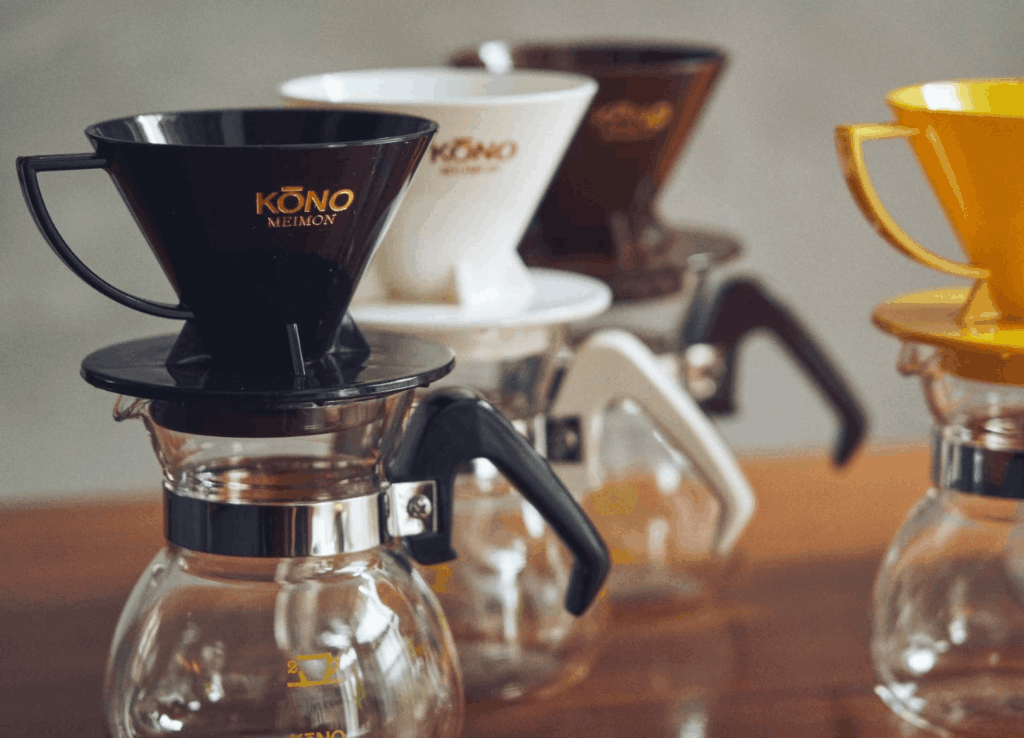
At AYANOMA, We prepare each cup of coffee by hand using equipment from COFFEE SIPHON CO., LTD., a Japanese manufacturer founded in 1925. Their KONO MEIMON Filter, developed in 1973, was the world’s first single-hole cone-shaped filter, designed to express delicate and nuanced flavors. In respect for Japanese craftsmanship and our admiration for KONO, we refer to our hand drip coffee simply as “KONO,” and mark it on the menu.
2. Carefully Selected Beans, Expertly Roasted
The beans we use are carefully roasted in Japan by Akimasa Kawakubo, one of the leading figures in the Japanese coffee industry, using his own unique techniques. They are then air-shipped to us to preserve their character. Like fine wine, our coffee evolves gently over time—please enjoy its refined and distinctive flavors.
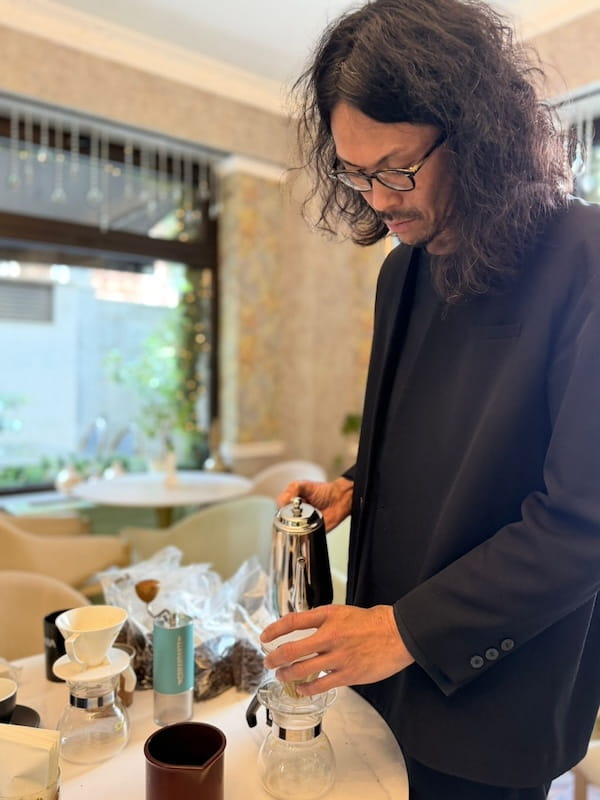
AKIMASA KAWAKUBO
Born in Osaka, Japan. He founded the Japan Coffee Festival, an initiative aimed at revitalizing local communities through coffee. He also operates a café, a coffee roasting facility, and a bakery in Osaka’s Yodogawa district.
In addition, he actively promotes KONO equipment both in Japan and internationally, while supporting projects related to coffee and culture.
3. Served in Traditional Japanese and Special Tableware
At Ayanoma, we serve coffee in “Mino ware,” traditional ceramics produced in Japan for over 1,000 years. We also use other special Japanese pottery, Georgian cups and mugs, and plates representing cultures from around the world. Ayanoma’s philosophy is dialogue through coffee— connecting Japan, Georgia, and cultures across the world.
Our Signature Blend “AWAI”
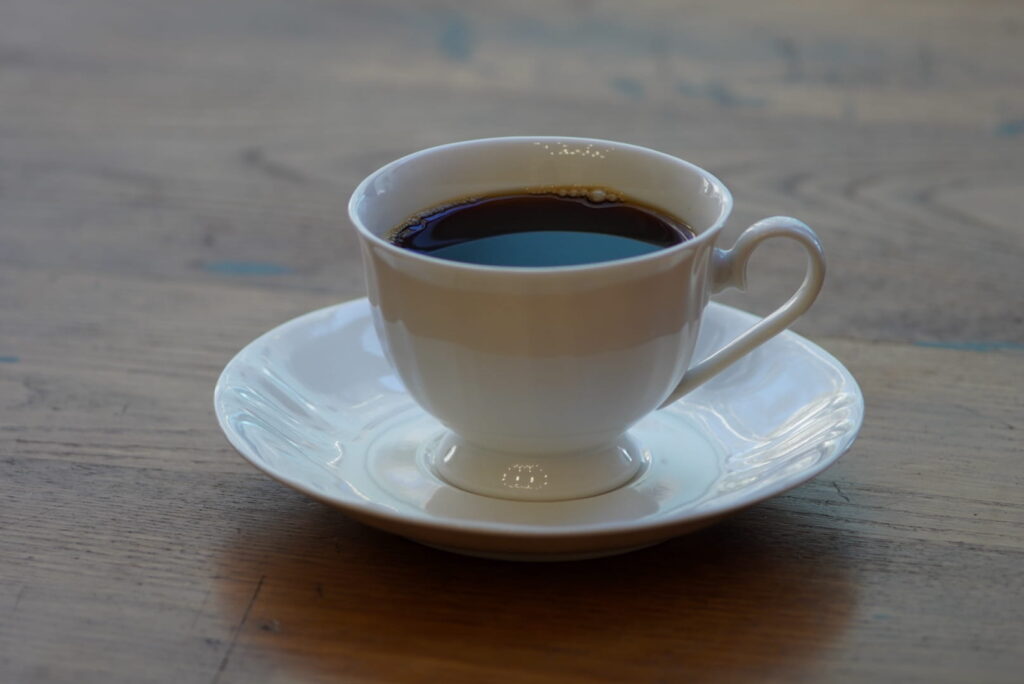
The blend coffees served at AYANOMA are given Japanese names. These names do not describe the types of beans, but instead express the concept, philosophy, and intended flavor profile of each blend.
“AWAI (間)” is a signature blend developed by Akimasa Kawakubo exclusively for AYANOMA, and can only be experienced here.
The kanji “間” has multiple readings—such as Ma, Ai, Aida, Awai, Hazama, Kan, Ken, and Gen—which vary depending on context, yet share a common core meaning: “between.” From this central idea, meanings such as space, time, relationship, and pause emerge.
So essential is this concept in Japanese culture that it even appears in the word for “human” (人間, ningen), reflecting the importance of time and connection between people.
Among these readings, “AWAI” is the most poetic and rarely used in everyday language. When read as “AWAI,” it carries the nuance of “the space between things facing one another,” or “the relationship between two elements.”
In the name of our café, Ayanoma (文乃間), the character “間” represents a space, time, or place that connects different elements—and our signature blend, “AWAI,” serves as the medium that brings those relationships together.
Using exclusively beans from Ethiopia, the birthplace of coffee, we have balanced a floral vibrance with a calm, refined depth. The way you perceive its flavor shifts according to the “MA” within your heart at that moment. A coffee for dialogue, where even the subtle shifts and differences in taste become something to cherish.
Easy Brew Coffee
Easy Brew coffee is brewed by simmering it in a kettle. Unlike hand-drip coffee, it offers a deeper and richer flavor.
The beans used are the blend coffee “FUKAI AO”, roasted by Akimasa Kawakubo and air-shipped from Japan.
Coffee brewed by simmering in a kettle is not unique to Japan. Methods such as hot-brewed and cold-brewed coffee have long been enjoyed around the world. However, with this style of extraction, if the beans are not properly roasted, unwanted bitterness and harsh flavors can easily be drawn out.
With Kawakubo’s carefully roasted beans, these unpleasant notes are almost entirely absent, resulting in a clean and enjoyable cup. Since the coffee can also be extracted simply by steeping a pack of grounds in water―without the need for simmering―it can be easily prepared and enjoyed at home as well.
When customer orders it hot, it is warmed and served using a traditional Japanese iron kettle called a Nanbu Tetsubin, which has been produced in Japan for over 400 years.
Using an iron kettle allows a small amount of iron to dissolve into the coffee, making the flavor even smoother and rounder.